What Should I Expect During My Child’s First ABA Session?
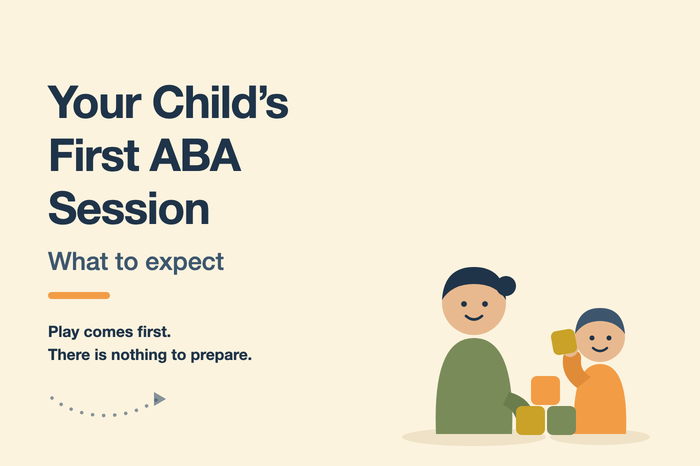
By the time the first session arrives, you have already done the hard part.
Most families reach this day after weeks of paperwork, phone calls and waiting. The questionnaire, the documents, the benefits check, the assessment, the report, the authorization, the search for the right therapist — all of that comes first. The first session is not the beginning of the process. It is the end of the beginning.
That is worth saying out loud, because a lot of parents arrive at this appointment carrying more nerves than they expected. You have been told what ABA therapy is. You have read the treatment plan. But you still do not know what it will actually feel like to watch a stranger sit down on the floor with your child. This article is about that hour.
Who will be in the room
In most sessions, the person working directly with your child is a Registered Behavior Technician, or RBT. They are the ones who will be with your child the most — often several times a week, for months. They are trained to deliver the plan and to collect the data that tells us whether it is working.
Behind that plan is a Board Certified Behavior Analyst, or BCBA. Your BCBA is the clinician who assessed your child, wrote the treatment plan and set the goals. They supervise the RBT and adjust the plan as your child responds to it. Depending on scheduling, your BCBA may be present for the first session, may join partway through, or may check in shortly afterward.
If two people show up, nothing has gone wrong. Supervision is a normal and required part of good ABA, not a sign that anyone is being evaluated or that your child is a difficult case.
What the first session is actually for
Here is the part that surprises people most: the first session is usually not about teaching anything.
The clinical term for what happens instead is pairing. The goal is to make the therapist someone your child is glad to see. That means the RBT will follow your child's lead, offer things your child already likes, and ask for very little in return. If your child wants to line up cars for forty minutes, there is a reasonable chance the first session involves a lot of lining up cars.
This is deliberate. A therapist who begins by making demands becomes a person to avoid, and a child who avoids their therapist does not learn from them. Time spent building that relationship early is not time lost. It is the foundation everything else is built on.
So if you were expecting flashcards and drills and a visible curriculum on day one, you may find the first session looks a great deal like play. That is the session working, not the session failing.
What it will probably look like
Sessions vary enormously, because children do. But a common shape for a first visit looks something like this.
The therapist arrives and spends the first stretch simply being present — near your child, not on top of them. They may sit on the floor at a distance and play with something interesting without asking your child to join. Many children come over on their own within a few minutes. Some take much longer, and that is fine.
From there, the RBT will follow whatever your child is drawn to and gradually become part of it: rolling a ball back, adding a block to a tower, taking a turn. They will be watching closely the whole time — what your child likes, what they avoid, how they ask for things, how they respond when something ends.
There may be a few small, easy requests toward the end. There may be none at all. Formal data collection on goals often does not begin in earnest until the therapist and your child know each other better.
The session will probably be shorter than your authorized hours suggest. Ramping up gradually is common, and how quickly that happens depends on your child.
What we will ask of you
Very little, and more than you might think.
Stay, if you can. You are not in the way. Watching the first few sessions is one of the most useful things a parent can do, because the strategies your child's team uses only work if they continue after the therapist leaves. You will hear more about that over time — parent involvement is a large part of why ABA generalizes beyond the therapy hour.
Tell us the unflattering things. What sets your child off. What they do when they are overwhelmed. What has failed with other providers. The first session goes better when the therapist already knows that your child hates the sound of the blender, or that transitions after screen time are the hardest part of your day.
Do not prepare your child too much. A brief, calm heads-up is plenty: someone is coming to play today. Long build-ups tend to raise anxiety rather than lower it.
Do not tidy the house into something it is not. If we are working in your home, we need to see the home your child actually lives in. The clutter is data, not a judgment.
If it goes badly, that is not a bad sign
Some first sessions are lovely. Some are not.
Your child may cry. They may hide, refuse to come out of their room, ignore the therapist entirely, or have a full meltdown ten minutes in. The session may end early. You may spend the evening wondering whether you have made an expensive mistake.
None of that means the placement is wrong, and none of it means your child has failed. A new adult in a familiar space is a significant change, and a strong reaction to a significant change is exactly what you would expect from a child who finds change hard — which is very often the reason a family sought ABA therapy in the first place.
What matters is what happens over the following weeks, not what happens in the first hour. If your child is still consistently distressed after several sessions, that is a real conversation to have with your BCBA, and it is a conversation we would want to have. But one difficult first session is not a verdict on anything.
Clinic, home, or school
Where the first session happens changes how it feels.
In our clinic, everything is unfamiliar, which can be harder at first and easier afterward — the space is set up for therapy, with fewer distractions and a structure that is easier to hold. It is also where practicing things like waiting, transitions and group activities is most straightforward.
At home, your child is on ground they know, which often makes the first meeting easier. The trade-off is that home is full of everything your child would rather be doing, and the skills are being taught in the middle of ordinary life.
At school, the therapist is working around a schedule they do not control and alongside people they need to build a relationship with. First sessions in schools often involve a good deal of quiet observation.
Different settings suit different goals, and many children work in more than one. The setting follows what your child is working on.
What happens after everyone goes home
Your therapist will write a session note. If any data was collected, it goes into your child's record and becomes the first point on a line you will be looking at for a long time.
You will not get a verdict that evening, and you should be suspicious of anyone who offers one. A single session with a child who has just met you is not enough information to say much. Meaningful patterns take weeks.
What you can reasonably expect is a short conversation at the end — how it went, what your child gravitated toward, what the plan is for next time. If nobody offers, ask. It is a fair question and it should have an easy answer.
Questions worth asking before your therapist leaves
- What did you notice that my child enjoyed most?
- What are you hoping to work on first, once the two of you know each other?
- What should I do if the same situation comes up when you are not here?
- How will I know whether this is working, and when should I expect to see that?
- Who do I call if something comes up between sessions?
One last thing
You do not have to get this right. You are allowed to be nervous, to hover, to ask the same question twice, or to close the door and let the therapist work while you sit in the kitchen and breathe.
Your child does not need you to be a co-therapist on day one. They need you to be the person who was already there — the constant in a week that has had a lot of new things in it. That is the whole job for now. The rest comes later, and you will not be doing it alone.
Find support for your child
Complete our questionnaire to know the next steps you can take to help your child succeed.