The Commitment Parents Bring to ABA Therapy: The Hidden Key to Real Progress
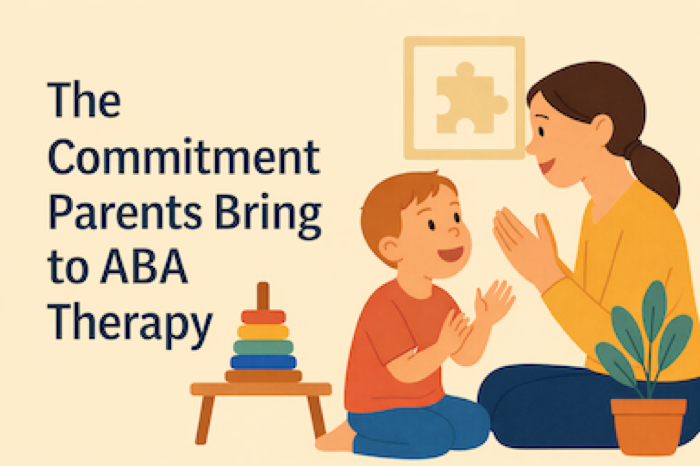
When a family begins ABA therapy, it’s not just a clinical process—it's the start of a shared journey. Research continues to show that children with autism make faster and more meaningful progress when their parents are actively involved.
A 2024 report from the Behavior Analysis Research Institute found that ABA programs with regular family participation achieved up to 45% more progress in communication, daily living skills, and emotional regulation compared to programs where parents were not involved.
The reason is simple: Children learn best from the people they trust most— their parents.
Why parent involvement matters so much
ABA sessions may take place in a clinic or at home, but real learning happens in everyday moments: during meals, playtime, bedtime routines, transitions, and family interactions.
When parents participate:
- Skills learned in therapy generalize into real life.
- Communication becomes more consistent and predictable.
- Motivation increases because reinforcement comes from loving caregivers.
- Anxiety decreases, making learning easier.
- The parent–child bond grows stronger.
A recent 2025 study from the National Center for Autism Research found that children whose families practiced ABA strategies for just 20 minutes a day showed improvements in:
- Expressive language
- Social play
- Frustration tolerance
- Flexibility with routines
Parents in the study also reported lower stress levels, feeling more confident in understanding their child’s needs.
The parent’s role: support, connection, and love
Parents are not expected to become therapists. They are expected to become active partners — and that makes all the difference.
Parents support ABA therapy by:
- Reinforcing positive behaviors during daily routines
- Modeling communication strategies
- Providing consistent expectations
- Sharing observations with the therapist
- Celebrating every success — big or small
A 2024 analysis from Stanford University concluded that the single most effective ABA interventions were not the longest or the most intensive… They were the ones where parents and therapists worked together as one unified team.
What the latest studies (2024–2025) reveal
Here are the most important research findings supporting parent involvement:
1. Active participation = stronger outcomes
The Global Autism Behavior Study (2025) evaluated 412 ABA programs in the U.S.
Results showed:
- +38% in functional communication
- +42% in adaptive skills
- +27% reduction in challenging behaviors when parents used ABA strategies at home at least 3 times per week.
2. Parents experience less stress
A 2024 trial published in the Journal of Developmental & Behavioral Pediatrics showed a 32% decrease in parental stress when caregivers received weekly ABA coaching.
3. Natural environments accelerate learning
The Harvard Lifespan Autism Project (2024) found that young children with autism learn new skills 2.5x faster when parents reinforce those same skills in natural settings — like the park, the kitchen, or the playroom.
4. Early intervention depends on home support
The Early Childhood Autism Outcome Report (2025) concluded: “The most successful early intervention is the one that extends beyond the therapist’s hour and into the family’s daily life.”
How to stay committed without feeling overwhelmed
Parent involvement shouldn’t feel like pressure. It should feel like connection.
Here are simple ways to participate without stress:
🌿 3 easy ways to start:
- Spend 10–15 minutes a day reinforcing one behavior your child is learning.
- Ask your BCBA what this week’s goals are and how you can support them at home.
- Praise attempts, not just perfect results — effort builds confidence.
Remember: You don’t have to be perfect. You just have to be present.
Your commitment is the bridge to your child’s progress
ABA therapy works best when parents and therapists walk the path together. Your involvement transforms a one-hour session into a full day of small learning opportunities.
When parents commit, results multiply and when love leads the way, children thrive.
Your participation is a powerful act of love — one that shapes your child’s future. And at BH Field, we’re here to guide you every step of the way.
Learn more about our family-centered ABA programs at bhfield.com or fill out our consultation form to start your journey with BH Field today.
Find support for your child
Complete our questionnaire to know the next steps you can take to help your child succeed.