Why Co-Regulation Matters: Foundation for Self-Regulation in Neurodivergent Children
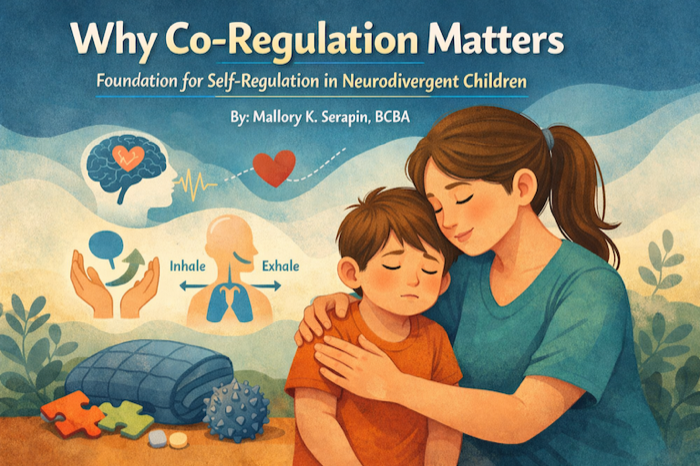
Self-regulation — the ability to manage emotions, attention, and behavior — is often described as a key developmental milestone. For many neurodivergent children, including those with autism spectrum disorder (ASD), achieving consistent self-regulation is a journey, not a quick destination.
What often gets overlooked is that before children can learn to regulate independently, they must first learn through co-regulation — the supportive, attuned interaction with a calm, regulated adult.
“Children do not learn to regulate from being regulated; they learn to regulate from being co-regulated.”
This simple truth shifts the focus from expecting immediate independence to nurturing foundational skills through secure relational support.
What Is Co-Regulation?
Co-regulation refers to the dynamic process in which a caregiver or adult supports a child’s emotional and physiological state through:
- Predictability
- Responsiveness
- Attunement
- Physical or verbal reassurance
(Tronick, 2007)
This process allows a child to externalize regulation with another person before gradually internalizing those skills.
In contrast to independent self-regulation, co-regulation recognizes that young children — especially neurodivergent ones — rely on relational support to navigate stressful states.
Research shows that co-regulated interactions strengthen neural pathways associated with emotional and behavioral regulation (Schore, 2001; Porges, 2011).
Why Co-Regulation Is Foundational
Many children with:
- Sensory processing differences
- Social-communication challenges
- Executive functioning delays
may experience dysregulation more frequently or more intensely than their peers.
Expecting a child to independently “pull themselves together” without providing emotional and physiological scaffolding is developmentally unrealistic.
Developmental expert Dr. Becky Kennedy emphasizes that co-regulation is not “spoiling” a child but rather supporting the nervous system’s development:
“Children are born wired for connection, and it is through that connection that they learn to regulate themselves.”
When caregivers model calm, respond predictably, and help children shift out of high-arousal states, they are not removing autonomy — they are building the capacity for it.
Examples of Co-Regulation Techniques
Below are evidence-based co-regulation strategies caregivers and ABA providers can use during interactions.
1. Mirroring and Validation
Reflect the child’s emotional state before guiding them toward calm.
Example:
“I see you’re really upset right now. That feels big.”
This validates emotional experience, supports neural integration, and reduces heightened arousal (Siegel & Bryson, 2011).
2. Rhythmic Breathing or Movement
Slow rhythmic breathing together (e.g., “breathe in for 4, out for 4”) can activate the parasympathetic nervous system, helping the body return to a calm state (Porges, 2011).
Movement can also help regulate the nervous system, including:
- Gentle rocking
- Slow swinging
- Walking together
3. Safe Physical Proximity
When appropriate and welcomed, a caregiver’s presence — even without words — can provide powerful co-regulatory support.
Proximity helps:
- Reduce threat cues
- Promote physiological calming
- Increase feelings of safety
4. Predictable Scripting
Using familiar phrases or routines during transitions creates predictability and emotional safety.
Predictability supports regulation and helps reduce anxiety (Rutter, 2017).
5. Sensory Supports Within a Co-Regulated Framework
Tools such as:
- Weighted blankets
- Deep pressure input
- Oral sensory tools
- Sensory breaks
can be helpful when used within a supportive interaction, rather than simply being given to the child without connection.
This helps children link self-soothing with relational support.
When Is It Appropriate to Expect Independent Self-Regulation?
Expecting independent self-regulation too early can lead to frustration and escalation.
Self-regulation tends to emerge after many successful experiences of co-regulation.
Signs a child may be ready to begin moving toward independent regulation include:
- Recognizing rising emotional states and communicating about them (through words, gestures, or AAC)
- Seeking support from a trusted adult before dysregulation escalates
- Using learned strategies (e.g., deep breathing or requesting a break) with fewer prompts
- Maintaining calm for longer periods in low-stress situations
Even as self-regulation develops, co-regulation remains helpful.
Think of co-regulation as training wheels — guiding and stabilizing while the skill develops.
How ABA Can Support Co-Regulation
Applied Behavior Analysis (ABA) has traditionally focused on observable behavior and skill acquisition.
Integrating co-regulation into ABA practice strengthens intervention by:
- Embedding relational support strategies within behavioral plans
- Teaching caregivers how to become co-regulatory partners
- Tracking emotional and physiological indicators alongside behavior data
- Measuring progress not only in independent performance but also in regulated interactions with supportive adults
Research shows that when caregivers are coached in responsive and attuned interactions, children demonstrate:
- Improved regulation
- Reduced behavioral challenges
- Stronger developmental outcomes
(Feldman, 2015; Bagner & Graziano, 2013)
Co-Regulation Is the Path to Self-Regulation
Co-regulation is not a detour from teaching self-regulation — it is the pathway to it.
Children learn most effectively through warm, responsive, and predictable relationships that allow their nervous systems to feel safe enough to explore, practice, and grow.
As Dr. Becky Kennedy reminds us:
“Regulation is not something you teach. It is something you do with someone.”
ABA providers and families who co-regulate with children create the environment where children can eventually:
- Internalize self-soothing skills
- Develop greater independence
- Participate confidently in everyday life
References
- Bagner, D. M., & Graziano, P. A. (2013). Behavioral parent training for families of toddlers with ASD: The role of emotion regulation. Journal of Autism and Developmental Disorders, 43(12), 2937–2951. https://doi.org/10.1007/s10803-013-1888-4
- Calkins, S. D., & Hill, A. (2007). Caregiver influences on emerging emotion regulation: Biological and environmental transactions in early development. Psychological Bulletin, 133(2), 244–263. https://doi.org/10.1037/0033-2909.133.2.244
- Cohen, J. (1998). Statistical power analysis for the behavioral sciences (2nd ed.). Lawrence Erlbaum.
- Feldman, R. (2015). Sensitive periods in human social development: New insights from research on oxytocin, synchrony, and human neurobiology. Development and Psychopathology, 27(2), 369–395. https://doi.org/10.1017/S0954579415000048
- Karreman, A., van Tuijl, C., van Aken, M. A. G., & Dekovic, M. (2006). Parenting and self-regulation in preschoolers: A meta-analysis. Infant and Child Development, 15(6), 561–579. https://doi.org/10.1002/icd.478
- Porges, S. W. (2011). The polyvagal theory: Neurophysiological foundations of emotions, attachment, communication, and self-regulation. Norton.
- Rutter, M. (2017). Child and adolescent psychopathology (6th ed.). Wiley.
- Schore, A. N. (2001). The effects of early relational trauma on right brain development, affect regulation, and infant mental health. Infant Mental Health Journal, 22(1–2), 201–269. https://doi.org/10.1002/1097-0355(200101/04)22:1/2<201::AID-IMHJ8>3.0.CO;2-9
- Siegel, D. J., & Bryson, T. P. (2011). The Whole-Brain Child: 12 Revolutionary Strategies to Nurture Your Child’s Developing Mind. Delacorte Press.
- Tronick, E. Z. (2007). The neurobehavioral and social-emotional development of infants and children. Norton.
- Van IJzendoorn, M. H., Schuengel, C., & Bakermans-Kranenburg, M. J. (1999). Disorganized attachment in early childhood: Meta-analysis of precursors, concomitants, and sequelae. Development and Psychopathology, 11(2), 225–249. https://doi.org/10.1017/S0954579499002035
- Zahn-Waxler, C., & Robinson, J. (1995). Empathy and caregiver–child mutual regulation. In N. Eisenberg & J. Strayer (Eds.), Emotion, regulation, and moral development (pp. 383–405). Cambridge University Press.
Find support for your child
Complete our questionnaire to know the next steps you can take to help your child succeed.